Most local SEO advice is a list of 40 things to do with no order and no timeline. This is the opposite: the 90-day sequence we run for service businesses, in the order that moves the map pack fastest, with the Search Console numbers from a real home services campaign so you know what "working" looks like at each stage.
It is written for contractors, clinics and any business where the customer searches "near me", looks at the map, reads a few reviews and calls. If that is you, the first 90 days decide whether SEO becomes a lead source or an expense. The plan below is the same one behind our local SEO service, and you can run most of it yourself.
Why 90 days, and what to expect each month
Google's local results are driven by three things the company itself names: relevance, distance and prominence. You cannot change distance, so the work is about relevance (does your profile and site clearly match the search) and prominence (how well known and well reviewed you are). Relevance can be fixed in weeks. Prominence compounds over months. That is why the roadmap front-loads profile and site fixes and back-loads reviews, pages and links.
Here is what a real campaign produced in its first three months, from a home services company's Search Console account, published with permission.
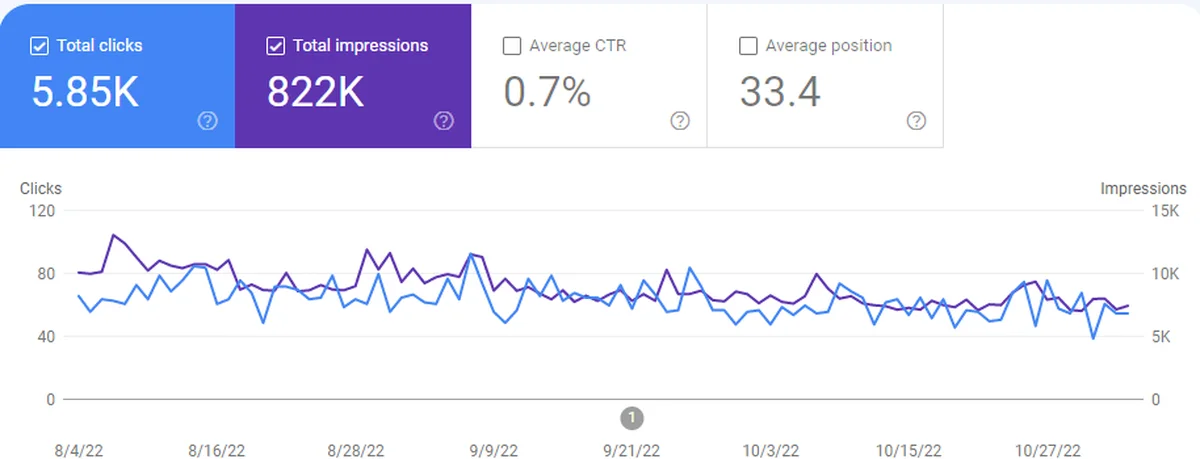
Notice the shape. Impressions grow first, then average position improves, then clicks. If you only track clicks in month one you will think nothing is happening. Track impressions and position too.
Weeks 1 to 2: audit and Google Business Profile
Start with a baseline so you can prove progress later. Record your map pack position for your five most valuable searches from three points in your service area (not just your office), your current review count and rating, and your Search Console clicks and impressions for the last 28 days. Our free keyword rank checker and website SEO checker cover the basics in a few minutes.
Then fix the profile, because it is the single biggest lever in the map pack:
- Primary category. Choose the most specific category that matches your main revenue service. "HVAC contractor" beats "contractor". Add secondary categories for other real services.
- Services and descriptions. Add every service you sell with a two-sentence description. These feed relevance directly.
- Business details. Hours, phone, website link to the right landing page (not always the homepage), service area set to the cities you actually serve.
- Photos. Twenty or more real photos: team, vehicles, completed work, office. Add five more every month. Stock photos do nothing.
- Attributes and Q&A. Fill every attribute that applies and pre-answer the ten questions customers ask by phone.
- Posts. One post per week from here on: a job you completed, a seasonal tip, an offer.
Finish the two weeks with a technical pass on the website. Confirm the site is indexable, loads in under three seconds on a phone, has one page per core service, and that the name, address and phone number on the site match the profile exactly. Anything broken here caps everything that follows, which is why our programs begin with an SEO audit.
Weeks 3 to 4: citations and the website foundation
Citations are mentions of your business name, address and phone number on other sites. They are no longer a ranking rocket, but inconsistent ones actively hurt, because Google loses confidence in which details are correct.
- Fix the big four first: Google, Apple Business Connect, Bing Places and Yelp.
- Then the data aggregators and the directories specific to your industry (for example, Houzz for remodelers, Healthgrades for clinics, Avvo for law firms).
- Use one canonical format for the name, suite number, phone and hours everywhere. Write it down and reuse it.
On the website, the foundation work is:
- A dedicated page for each core service with real detail: process, pricing ranges, timelines, photos, FAQs. Our industry pages, for example SEO for HVAC companies and SEO for plumbers, show the page structure we use.
- A contact page with the full business details, an embedded map and a form that works on phones.
- Internal links from the homepage to every service page, and from every service page to the contact page and the relevant area page.
- LocalBusiness schema with the same details as the profile, validated with the schema checker.
By the end of week four most businesses see their branded searches and a few low-competition service terms move. That is the profile and the site becoming clearly relevant.
Weeks 5 to 8: service area pages and the review system
Service area pages that are not duplicates
If you serve several cities or neighborhoods, each important one deserves a page, but only if the page says something true and specific about that area. Pages that swap the city name and keep everything else are the most common reason local sites get filtered. For each area include: projects completed there, local regulations or permit notes, typical travel time, nearby landmarks you serve, and reviews from customers in that area. Our city pages, such as SEO company in Miami and SEO company in Chicago, follow the same rule: every one is written for its market, not generated.
Link each area page from the main service pages and from a "service areas" section on the homepage. Keep the count honest. Five strong area pages beat thirty thin ones.
A review system you can keep running
Reviews are the prominence signal you control most directly, and they influence the click as much as the ranking. Build a system in week five and never stop:
- Ask at the moment of satisfaction, in person or by text, with a direct link to the review form.
- Ask every customer, not just the happy-looking ones. Volume and recency both matter.
- Reply to every review within two days. Replies to negative reviews are read by future customers more than the reviews themselves.
- Never incentivize or gate reviews. It breaks the platform rules and the penalty is losing them all.
A realistic target for a single-location service business is four to eight new Google reviews per month. Where a competitor has 300 reviews and you have 30, this is also the gap that decides the map pack, and it only closes with a system.
Weeks 9 to 13: links, content and local prominence
With relevance fixed, the last month is about becoming known in your market. This is the part most local businesses skip, and it is where the campaign above went from impressions to clicks.
- Local links. Sponsor a youth team, join the chamber of commerce, partner with complementary businesses, get listed on supplier and manufacturer sites, pitch a local news story. Each is a link from a site that is clearly local, which is the strongest prominence signal most competitors lack. See how we approach this in link building.
- Helpful content for your area. Cost guides, seasonal checklists, "what to do when" pages. A plumber's "what to do when a pipe bursts" page earns links and brings in the customer who needs a plumber tonight.
- Google Business Profile posts and photos continue weekly. Profiles with recent activity hold positions better than dormant ones.
- Expand service pages with FAQs pulled from Search Console queries and People Also Ask, which also feeds the answer engine side of search.
Tracking the right way: the rank grid
Map rankings change by where the searcher is standing. Checking from your office tells you almost nothing about the customer eight miles away. Use a grid-based tracker: a set of points across your service area, each checked for your main keywords, colored by position. The home page of this site shows what one looks like. Before the roadmap, most businesses are green near the office and red everywhere else. The goal of the 90 days is to turn the ring around your office green, then push outward.
Report monthly on five numbers: points in the top three on the grid, average grid position, Google Business Profile calls and direction requests, organic clicks, and leads from organic. The last one is the only one your accountant cares about.
Common mistakes that stall local campaigns
- Starting with content before the profile and site are fixed. Articles on a site with a half-empty profile and mismatched citations do not rank.
- Keyword stuffing the business name. "Joe's Plumbing Houston Emergency Plumber 24/7" gets suspended. Use your real name.
- One page listing ten services. It ranks for none of them. One service, one page.
- Fake area pages. City-swapped pages get filtered and drag the rest of the site down with them.
- Stopping reviews after the first push. Recency matters. A burst of reviews in March followed by silence looks worse by August than a steady four a month.
- Quitting in month three. The curve bends between months three and six, as the Search Console report above shows. Most failed campaigns were stopped just before that.
What this costs and when to get help
Everything above can be done in-house by a disciplined owner or office manager with about five hours a week, and SEO consulting can supply the plan and reviews if you want a second pair of eyes. Where businesses bring us in is when they lack that time, serve multiple locations, or are in a market where the competitors already have a hundred reviews and a page for every suburb. Our local SEO packages start with a single-location plan that covers the profile, citations, review system, area pages and the rank grid report, month to month after onboarding. If you want to know where you stand first, request a free audit and we will send the baseline and the 90-day plan for your business.
Getting your business ready for AI agents
The same foundations, consistent listings, published prices and a simple booking path, are what AI assistants need when they compare and book local services for users. If you are finishing this roadmap, the next step is our AI agent optimization checklist.
FAQ
How long does local SEO take to work?
Profile and relevance fixes often show movement within two to four weeks on branded and low-competition searches. Competitive map pack terms usually take three to six months, because prominence signals like reviews and local links compound over time.
Do I need a separate page for every city I serve?
Only for the areas that matter commercially and only if you can write something true and specific about each one. A handful of detailed area pages outperform dozens of city-swapped duplicates, which Google filters.
How many Google reviews do I need?
Enough to match or beat the businesses currently in the map pack for your searches, and a steady flow afterward. For most single-location service businesses that means four to eight new reviews a month, every month.
Should I use a tracking number on my Google Business Profile?
Yes, if you set the tracking number as the primary number and list your real number as an additional number, so the name, address and phone details stay consistent across the web. Call tracking is how you prove the profile is producing leads.
What is a local rank grid?
A map of your service area divided into points, each showing where you rank for a keyword when the search happens from that spot. It replaces the misleading single check from your office with a true picture of visibility across the whole area.
Can local SEO help if I do not have a storefront?
Yes. Service area businesses can hide their address and set the areas they serve. The roadmap is the same, with more weight on area pages, reviews that mention locations, and local links, since there is no storefront prominence to lean on.
If this guide was useful, add RankEmpire as a preferred source on Google to see more of our articles in Top Stories.
Make RankEmpire a preferred source on Google
SEO strategist and funnel builder with 12+ years in search. Leads every RankEmpire account personally: the audit, the 90-day roadmap and the monthly call.
See the verified Search Console results or request a free SEO audit.
 SEO Strategy
 SEO Strategy
 SEO Strategy